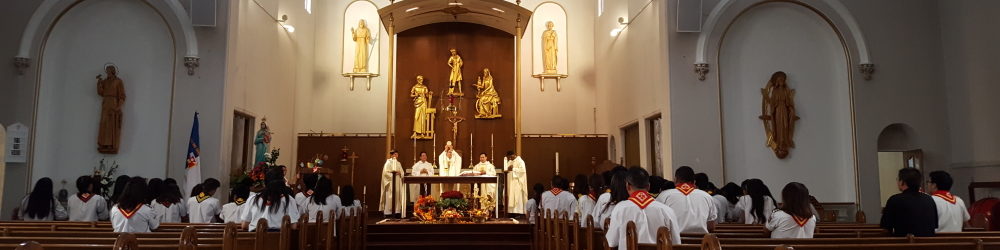

Parishioners across the western half of North Carolina are using their voices publicly and in prayer in hopes of persuading Bishop Michael Martin, OFM Conv., to reverse course from the liturgical changes he has made in the Diocese of Charlotte over the past eight months.
They join their pastors and priests in expressing their concern.
A group of pastors met with Bishop Martin after the first change was announced in May 2025 when the new bishop issued a pastoral letter noting that he’d be moving parish-based celebrations of the Traditional Latin Mass to a single chapel, which is too small to accommodate all who attend the liturgy. Shortly afterward, a leaked document of additional changes fueled the controversy, which rippled across the global Church.
As it became clear that Bishop Martin was not budging on these or the recent Eucharistic norm changes, 31 priests in the diocese on Jan. 5 submitted dubia, or questions, to the Vatican about the authority of a bishop to make such changes, as CatholicVote reported.
Since the most recent changes — including the banning of altar rails and prie-dieus — were announced just before Christmas in 2025 more members of the faithful have spoken up publicly. This included Andrew Dunn from St. Ann Catholic Church in Charlotte, who wrote a Dec. 28 op-ed in defense of the sacred, explaining how outward expressions are visible reminders of spiritual realities.
The next week, an anonymous mother at a parish affected by the changes wrote an open letter pleading with Bishop Martin to reconsider. Posted Jan. 4 by Catholic blogger Brian Williams at “Liturgy Guy,” the letter respectfully urges the bishop to reconsider the sweeping changes.
Framed as a response to a homily Bishop Martin gave during a pastoral installation at St. Matthew Catholic Church in September 2025, the letter draws from the bishop’s own metaphor of “soft crabs” — creatures shedding their hardened shells to grow.
The mother wrote, “I simply ask you, your Excellency, to abide by what you say — by practicing what you (literally) preach.”
At the heart of the letter is a plea for openness to tradition and a more dialogical approach to reform. The mother questioned whether the bishop’s discomfort lies in practices cherished by many faithful: Latin Mass, Communion at altar rails, and the presence of reverent tradition within the diocese.
“Uniformity is not unity, and it’s causing more division than we have ever felt,” she wrote, warning that recent mandates risk discouraging vocations and sowing division in parishes once marked by rich liturgical life and thriving seminarian numbers.
Then, on Jan. 15, dozens of parishioners gathered outside the diocese’s pastoral center in Charlotte to pray the Rosary in hopes that the altar rails could remain in use.
After the ban on altar rails took effect Jan. 16, The Catholic Herald reported that implementation of the revised Eucharistic norms varied throughout the diocese where rails or kneelers for Communion had been in use.
Some parishes, the outlet reported, are waiting to hear a response from the Vatican on the dubia, whereas others are now forming a single line for Communion with no assistance for those who choose to kneel.
“Altar rails have been part of my experience since childhood,” Bredon Kimel, a parishioner at St. Thomas Aquinas Parish in Charlotte, told the Herald. “My father was an Episcopal priest and we had altar rails. When I converted to Catholicism, I was shocked to learn they were mostly removed from churches after Vatican II.”
He added, “To me, altar rails evoke reverence, beauty and tradition. Reverence because of the kneeling and the separation of the sanctuary, beauty because of the aesthetic, and tradition because this is how it’s been done for ages. I’ve heard no good or even coherent reasons for discontinuing it.”
Kimel then expressed exasperation over the bishop’s changes.
“The fact that so many parishes in his diocese are strongly traditional, and that many of the laity find in it a source of spiritual foundation and zeal, from which so many vocations have come, shows what kind of zealot he is that he would seek to ban immediately the things so many have come to rely upon in their spiritual life,” he told the Herald. “This is not a legitimate use of his authority.”
Parishioners wishing to keep the liturgical practices, including the parish-based celebrations of the Traditional Latin Mass, donated thousands of dollars over the summer of 2025 to produce “Bread Not Stones,” a documentary about the beauty and importance of the ancient liturgy as well as the spiritual harm of its limitation in the diocese, as CatholicVote reported at the time. Produced by Sean and Tracy O’Halloran, the film features a number of devotees who express their love for the traditional Mass.
These are just a few of the many seen and unseen pleas of laity in the Diocese of Charlotte. They are accompanied by much concern outside of the diocese, too. One example is Father Steve Mattson of Michigan, who aptly expressed the sentiments of those in Charlotte’s in his “Baffled by a Bishop” blog entry republished in Catholic World Report on Dec. 30, 2025.
“Bishop Martin seems to believe that the faithful are kneeling because someone told them to. My sense is that when the faithful see others kneel, they often desire to do so too,” he wrote. “It’s not people telling them what to do, but rather others showing them what’s possible.”
He then explained that he had rarely distributed communion at an altar rail until the renovation at his church that included one.
“I was struck to see my sons and daughters in Christ at the altar rail. Whether kneeling or standing, they were waiting patiently and (so it seemed to me) prayerfully to receive the One they came to worship.
“An altar rail is not just a physical aid to those who need it. In my experience, it allows a bit of “holy tarrying” in the presence of the Lord, as the faithful wait for me or an extraordinary minister of holy communion to bring the host to them. Even though it allows such prayerful tarrying, it’s more efficient in terms of time required for the distribution of Holy Communion. In my book, that’s a win-win.”

The post Faithful in Charlotte diocese continue to stand up for traditional liturgical practices that feed their faith appeared first on CatholicVote org.