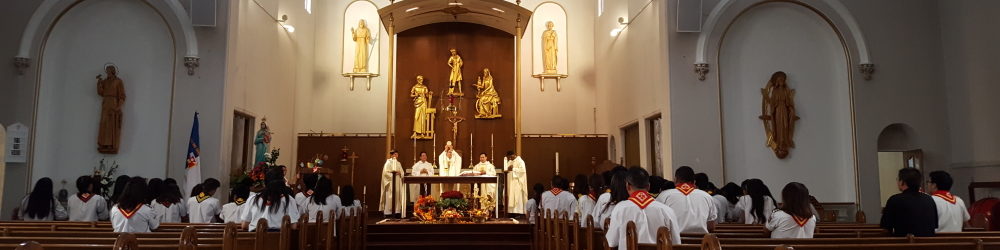

As Christmas joy fills the pews of churches in the Diocese of Charlotte, North Carolina, many parishioners are also experiencing sorrow as they brace for the end of a beloved tradition.
Bishop Michael Martin announced just before the celebration of Christ’s birth that by Jan. 16, 2026, all parishes in the diocese must stop offering Holy Communion at altar rails and return to receiving while standing in line. Movable structures used for kneeling will also not be allowed.
The change has stirred deep reflection for many in the diocese, especially those drawn to traditional forms of worship. Andrew Dunn, publisher of Longleaf Politics wrote in a recent guest column for The Charlotte Observer that the altar rail is more than a structure — it represents awe for the divine.
“Kneeling to receive Communion reinforces in us that the sacred is real,” wrote Dunn, a former Lutheran who is now a parishioner of St. Ann Catholic Church in Charlotte. “Traditions like that are more important than they appear, especially in a time when even many Catholics seem unsure about what the Church actually teaches about the Eucharist.”
The decision follows a series of moves by the bishop that have sparked debate among the faithful. In recent months, Dunn noted, Catholic schools in Charlotte have shifted their focus more explicitly toward faith formation — a welcome change for some and a frustration for others who had enrolled their children primarily for academics.
In May, Bishop Martin announced the end of the celebration of the Traditional Latin Mass in parish churches, sparking a controversy that has drawn criticism throughout the global Church.
>> Faithful fill Mooresville chapel on first Sunday of TLM restrictions in Charlotte diocese <<
The tension was subsequently fueled by a leaked draft of proposed liturgical changes for the diocese, which included the one regarding the norms for receiving Communion that has now been made official.
Together, these changes raise a deeper question, according to Dunn. What does unity look like in a Church that spans centuries, cultures, and liturgical expressions?
As North Carolina experiences rapid growth and social flux, institutions like the Church are being tested as places of stability and transcendence, he noted.
“Families, neighborhoods, and churches, all find themselves under pressure — the very places that keep people grounded in something bigger than themselves. The debate over a Communion rail is not really about carpentry,” Dunn wrote. “It is about whether we still believe the small practices that form us matter.”
For Dunn and many others like him, the beauty of Catholicism lies in its reverent traditions, its embrace of “both/and” in a Church that is at once ancient and ever new.
Dunn wrote that the traditional reverence he has found at St. Ann has borne fruit in his life.
“In a restless era, small rituals are often how institutions hand down their deepest truths,” he added. “They teach gratitude. Humility. Awe. They teach the ability to submit to something higher than the self. Those aren’t just church virtues. They’re civic ones, too.”

The post Charlotte parishioner writes op-ed supporting kneeling to receive the Eucharist as bishop bans altar rails appeared first on CatholicVote org.