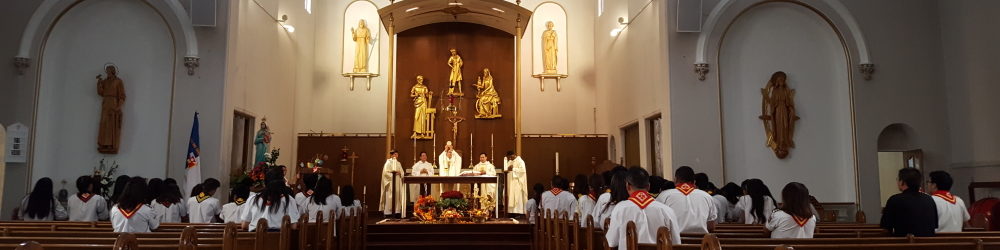

Marking a new chapter in the Church’s engagement with young people, Pope Leo XIV addressed the National Catholic Youth Conference Nov. 21 by joining thousands of teenagers via live video for a 45-minute conversation broadcast worldwide by EWTN. He addressed topics of AI and homework, distractions during prayer, accepting God’s mercy, and more.
NCYC, held every two years, is one of the largest gatherings of Catholic teens in the U.S.This year’s event marked the first time the Holy Father personally addressed participants during the conference.
“What a blessing it is to see so many young Catholics seeking the Lord with sincerity and joy,” he said at the start of the dialogue. “Young people, you all hold a special place in my heart.”
Hosted by Catholic speaker Katie Prejean McGrady, the livestream centered on questions five high school students posed to the Holy Father. The questions had been developed by a team of 30 teens over several months.
Mia from Maryland: Making mistakes and accepting God’s mercy
Mia, a student from the Archdiocese of Baltimore, Maryland, opened the discussion with a question about the sacraments. She asked whether the Pope himself ever finds it difficult to accept God’s mercy after making mistakes or letting others down.
“In my experience, it’s been difficult to voice my mistakes,” she said. “Is it hard for you to accept God’s mercy when you make mistakes, or feel like you’ve let people down?”
Pope Leo responded by reminding her that everyone struggles with this at times, and the truth is that no one is perfect, but sin “never has the final word.”
“[Jesus] forgave the good thief and prayed for those who crucified Him,” Pope Leo said. “We may struggle to forgive, but God’s heart is different. God never stops inviting us back.”
This mercy is experienced particularly in the Sacrament of Confession when one confesses his or sins honestly and receives absolution from the priest “and we know with certainty that we are forgiven,” Pope Leo said. “So yes, it can be discouraging when we fall, but do not focus only on your sins. Look to Jesus, trust His mercy and go to Him with confidence, He will always welcome you home.”
Ezekiel from California: Mental Health, burdens, and friendship
Ezekiel, a student from the Archdiocese of Los Angeles asked the Pontiff how to surrender problems to God when feeling overwhelmed and how to communicate struggles to others.
The Pope began answering the question by emphasizing that Jesus does not observe human suffering from afar but draws near to those who struggle. He recalled how in 1 Peter, the apostle writes, “Cast all your worries on Him because He cares for you.”
Pope Leo added, “He knows when life feels heavy, and Scripture reminds us that he is near to the brokenhearted, even when we do not feel His presence.”
The Pope said he sees clearly that young people carry “authentic joys and hopes, but also struggles and heavy burdens” and urged them to seek trustworthy people — which may include parents, teachers, priests, and friends — who can accompany them.
“When you find someone you truly trust, don’t be afraid to open your heart,” he said. “A real friend is not only someone who’s fun to be with, though that is good too, but it’s someone who helps you grow closest, someone who encourages you to become a better person. Good friends also push us to seek help when life gets difficult or confusing, good friends will always tell us the truth, even when that’s not easy to do.”
He encouraged the teens to pray for the gift of real friendship, citing Scripture: “Faithful friends are like a strong shelter and a treasure.”
Christopher from Nevada: Technology, screens, and balance
Christopher from the Archdiocese of Las Vegas asked for advice on the challenge of constant phone use.
“I often find myself sitting on my phone, endlessly scrolling,” he said. “I’ve also noticed that everybody around me is the same or has a very similar problem.”
Pope Leo encouraged Christopher — and anyone who struggles with phone distractions — to look to the temperate example of Saint Carlo Acutis, be aware of phones’ limits, and use technology for good.
“Technology can really help us in many ways, including can help us live our Christian faith,” Pope Leo said. “It lets us stay connected with people who are far away, as today, when we can see and hear each other, even though we’re thousands of miles apart. It also gives us amazing tools for prayer, for reading the Bible, for learning more about what we believe, and it allows us to share the gospel with people we may never meet in person.”
He added, “but even with all that, technology can never replace real in-person relationships. Simple things, a hug, a handshake, a smile, all those things are essential to being human.”
He held up St. Carlo Acutis as an example of discipline and digital balance, noting that St. Acutis “allowed only a certain amount of time each week for leisure on his electronic devices” so he could keep his priorities rooted in joy and faith.
Micah from Hawaii: ChatGPT and artificial intelligence
Micah, from the Diocese of Honolulu, brought up AI and ChatGPT.
“Many of us, including myself, can rely on using AI or chatGPT to assist in finding solutions and things such as our schoolwork, like writing a good essay or walking us through a math problem or answering a history question and really using AI as a tool or a resource to to find solutions and an answer to a problem that we may have,” he said.
He asked the Holy Father what he should be cautious of when using this new technology.
Pope Leo stressed that responsibility still lies with the human person: “Filters and guidelines can help you, but they cannot make choices for you. Only you can do that. These years of your life are meant to help you grow into mature adults, spiritually deepening your friendship with God and becoming more like Him. Intellectually, it means learning to think clearly, to think critically, to examine reality and to search for truth, beauty, and goodness.”
“It also means strengthening your will with God’s grace so you can freely choose what helps you grow, avoid what harms you. Tools we’re given, including AI, should support that journey, not weaken it,” he added. “Using AI responsibly means using it in ways that help you grow, never in ways that distract you from your dignity or your call to holiness in your education, make the most of this time.”
He warned teens not to outsource thinking or intellectual growt to machines: “AI can process information quickly, but it cannot replace human intelligence. And don’t ask it to do your homework for you.”
He also added that AI “cannot offer real wisdom. This is a very important human element. AI will not judge between what is truly right and wrong, and it won’t stand in authentic wonder, before the beauty of God’s creation.”
He invited the teens to use AI in such a way that “if it disappeared tomorrow, you would still know how to think, how to create, how to act on your own, how to form authentic friendships.”
“AI can never replace the unique gift that you are in the world,” he said.
Elise from Iowa: The future of the Church
Elise, from the Archdiocese of Dubuque, Iowa, asked how the Church is preparing for the future. Pope Leo pointed the teens back to Christ’s promise and the constancy of the gospel.
“When we face challenges or worries about the future, it might be good to remember that promise that Jesus once made to Peter when He said the gates of Hell will not prevail against the Church,” he said. “The Church prepares for the future by staying faithful to what Jesus asks of us today.”
He also answered a question from McGrady about how he deals with distraction in prayer.
“Sometimes the best thing to do is to follow the distraction for a moment, see why it’s there, but then to turn back and to remember why you’re there and why you’re in prayer, and to say to the Lord, ‘Look, Lord, I’m distracted right now. I know You understand,’ but not to allow yourself to be taken too far away, especially during prayer,” Pope Leo said. “Because there are all kinds of temptations and all kinds of distractions, but there’s only one, Jesus Christ, and we really need to give our time also in prayer to Christ.”
He urged teens to trust the guidance of the Holy Spirit, listen to their bishops, and take their place in the Church’s mission.
“The Church needs all of us, including you,” he said.
Elise also asked how young people can ensure they are part of the conversation about the Church’s future.
“Let me begin with something important. You are not only the future of the church. You are the present,” the Pope said.
He encouraged them to stay engaged in parish life, attend Mass, join youth groups, deepen their prayer life, and consider their vocation.
“Do not settle for a shallow version of faith. Seek the real friendship that Jesus offers you. Listen to Him in prayer and let Him shape your life,” Pope Leo said. “When you do this, you carry His presence into the world with joy, hope, with creativity. Jesus also calls His disciples to be peacemakers, people who build bridges instead of walls, people who value dialogue and unity instead of division.
“Please be careful not to use political categories to speak about faith, to speak about the Church. The Church does not belong to any political category; rather, she helps form your conscience. The Church helps form your conscience so you can think and act with wisdom and love.”
“As you grow closer to Jesus, do not fear what He might ask you,” he added. “If He challenges you to make changes in your life, it’s always because He wants to give you greater joy, greater freedom. God is never outdone in generosity.”
He pointed to Saint Pier Giorgio Frassati as a model of simple, daily holiness and left teens with three questions to reflect on going forward:
What can I offer the Church for the future?
How can I help others come to know Christ?
How can I build peace and friendship around me?

The post Pope Leo speaks on AI, God’s mercy, friendship in livestream conversation with young people appeared first on CatholicVote org.