The INSIDER is our weekly email exclusive to Champions who make a monthly commitment to support the work of CatholicVote. We thought we would share this week’s INSIDER with everyone. Don’t miss a single edition of the INSIDER. Sign up today to become a Champion of the CatholicVote.
This week’s INSIDER comes from CatholicVote Vice President Joshua Mercer
Visiting Spain was remarkable.
Of course, the food was fantastic. I’ve never had better veal in my life. One restaurant could be mistaken for Valhalla. They brought a plate that I could only describe as a Mountain of Meat. They are experts at preparing pork in so many different ways. And while I’m not much of a connoisseur of seafood, I rather enjoyed having octopus, clams, and even squid.
But it wasn’t just great food (and wine) that drew me to Spain.
You might be familiar with Lourdes and Fatima – but not enough Catholics know about a major pilgrimage site in Spain: Santiago de Compostela or the burial site of the Apostle James. Each year, hundreds of thousands of people (Christian and otherwise) walk different Camino routes towards the city of Santiago (Spanish name for St. James) to reach the beautiful cathedral. (Camino means “the Way”).
As Editor of the LOOP, I was delighted to be a guest of the Tourism Office of Spain to let Catholics in America know about the rich religious heritage of Spain.
You likely know that after Pentecost, the Twelve Apostles were sent out across the known world to spread the Gospel. Saint James (the Greater) went westward and spent several years preaching in Hispania or the Roman name for the Iberian peninsula.
On his last journey back to Jerusalem, St. James was beheaded by order of Herod Agrippa. According to tradition, the body of St. James was moved by angels and sailed in a rudderless boat to northwest Spain. Disciples of St. James would eventually secure a safe place for St. James’ tomb – only for the location to be forgotten for centuries.

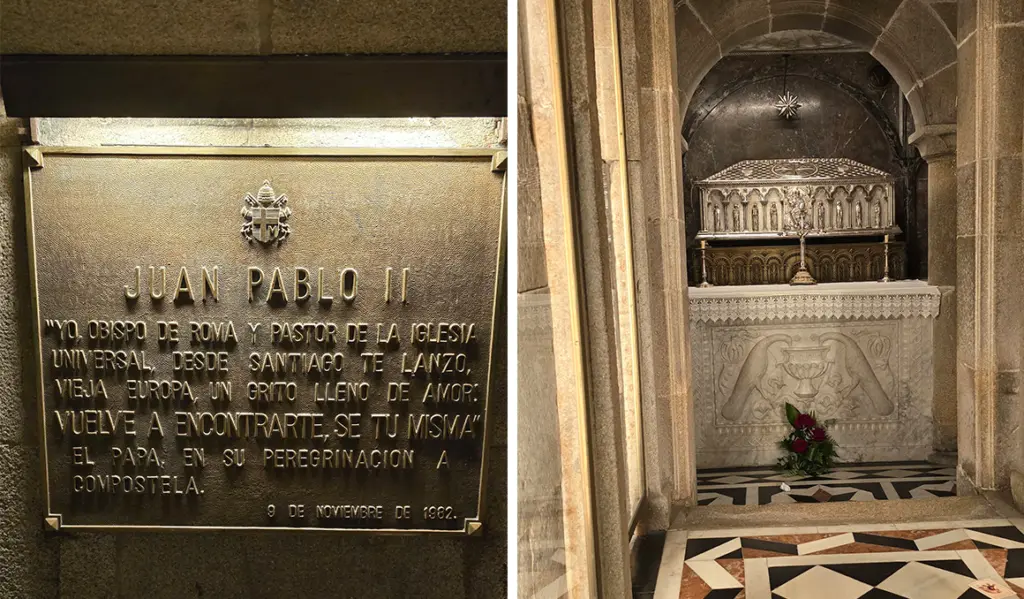
Near the Apostle’s tomb today rests a plaque from Pope John Paul II, who visited this holy site in 1982. Translated into English, his message reads: “I, Bishop of Rome and Pastor of the universal Church, from Santiago, launch to you, old Europe, a cry full of love: find yourself again, be yourself.”
Find yourself, indeed.
Europe today is once again facing a crisis of civilizations. We would do well to heed St. John Paul’s words and remember our history. To be fair, many of us were never taught this history to begin with.
Muslims from North Africa crossed the Straits of Gibraltar and invaded Spain and Portugal in the year 711. It took just five years for Muslims to conquer 90% of the Iberian Peninsula. By 720, Muslims had established a caliphate (an Islamic theocracy) in Spain. Christians held but a sliver of territory in the mountains of northwest Spain.
Thankfully, these Christians did not give up and began a campaign to win back their country, called the Reconquista of Spain. And you simply cannot think about the Reconquista without the Apostle St. James.

Islamic forces had control of Spain for a century when a Christian hermit named Pelagius saw a shower of stars on the same hill in the forest every night. With the help of his bishop’s men, they discovered a stone sepulchre with the Apostle’s body, alongside his two disciples.
The bishop immediately recognized this as a miracle. King Alfonso II, whose kingdom was also in northern Spain, ordered the construction of a chapel on the site of the Apostle’s tomb. The pilgrimage route the king took to reach the site became known as the Camino Primitivo (the Primitive Way) – or the oldest and safest route to the shrine of St. James. (Today, there are many different routes, coming from Portugal, France, and all throughout Spain).
The discovery of the Apostle’s tomb would prove the spark that would turn Spain around and St. James was declared the country’s patron saint. Christians would invoke his name to push back the Islamic invaders and take back portions of their country. It wasn’t just his memory. At the Battle of Clavijo, a miraculous figure (considered to be St. James himself) appeared and helped defeat the Muslim Moors.

While it only took five years to lose their country, it would take 800 years to win it back! (Let that be a lesson for us all!)
The very last battle in the Reconquista of Spain occurred in 1492. That same year, Queen Isabella, clearly confident in victory, agreed to finance a trip by an Italian explorer named Christopher Columbus to find a new route to India.
If Spain had remained an Islamic caliphate, there’s no way Queen Isabella could have financed Christopher Columbus’ expedition.
In fact, if Spain had remained Islamic, Islam may have expanded further, making Europe a very different place today. And we wouldn’t be preparing to celebrate America’s 250th birthday!
May we never lose our Way.
The post Visiting St. James in Spain appeared first on CatholicVote org.