CatholicVote President and CEO Kelsey Reinhardt delivered one of the most talked-about breakout sessions of the SEEK Conference on Saturday afternoon, arguing that the late Charlie Kirk’s influence on American culture was not merely political, but also spiritual, and that Catholics ignore politics at their peril.
The session, titled “The Charlie Kirk Effect: Why Christian Witness in the Political Sphere Is So Important,” drew a large number of college students and young adults eager to understand how faith, courage, and civic engagement intersect in an increasingly hostile public square.
Reinhardt opened by recalling the shock of Sept. 10, 2025, when Kirk — founder of Turning Point USA, father of two, and one of the most prominent conservative voices on college campuses — was assassinated in broad daylight.
“There are moments in history that pierce the soul of a generation,” Reinhardt said. “September 10 was one of them.”
She recounted how CatholicVote staff immediately gathered to pray a rosary upon learning of Kirk’s death, and how, in the days that followed, figures such as Bishop Robert Barron and Cardinal Timothy Dolan publicly described Kirk as an “apostle of civic discourse” and even a “modern Saint Paul.”
What became clear, Reinhardt argued, was that Kirk’s influence far outpaced conventional political metrics.
Citing a post-assassination Barna Group survey of 5,000 adults, Reinhardt noted that roughly 18 percent of Americans reported becoming more spiritually active after Kirk’s death, compared to just 5 percent who said they became more politically active. Among Gen Z respondents, the contrast was even sharper: 22 percent reported increased prayer, church attendance, or Scripture reading, while only 7 percent reported greater political engagement.
“For a man primarily known for politics, the spiritual fruit is astounding,” Reinhardt said.
She pointed to the flood of social-media tributes highlighting Kirk’s unapologetic Christian witness on college campuses, his pro-life arguments grounded in reason and Scripture, and his now-widely circulated statement, given just months before his death: “I want to be remembered for courage for my faith.”
Reinhardt also recalled Kirk’s widely viewed funeral, watched by more than 100 million people worldwide, which she described as one of the most explicit public testimonies to the lordship of Jesus Christ in recent political memory. She cited remarks by Sen. Marco Rubio and Vice President JD Vance, who publicly reflected on salvation history and their own renewed willingness to speak openly about faith.
According to Reinhardt, Kirk’s unique impact flowed from his willingness to enter the most ideologically rigid spaces in American life — secular college campuses — and ask questions that modern culture had declared off-limits.
“Charlie didn’t just debate policies,” she said. “He asked the higher questions: What gives a human being dignity? What is justice? How should society be ordered? Is there a hierarchy of goods or of evils?”
Those political questions, Reinhardt argued, became an unexpected gateway back to faith for many young people, especially Gen Z men increasingly disillusioned with moral relativism and cultural incoherence.
She contrasted polling data showing that young men aligned with conservative politics increasingly prioritize marriage and having children, while their progressive peers rank family formation near the bottom of their aspirations.
“This is what I call the Charlie Kirk effect,” Reinhardt said. “Politics isn’t neutral. It flows from what you believe about the human person.”
From there, Reinhardt turned her focus squarely on Catholics.
She warned against what she described as “political pietism,” the temptation among devout believers to retreat from public life because politics is “too dirty” or “too worldly.”
“Jesus didn’t say, ‘Go and proclaim the Gospel… unless it gets political,’” she said. “The Great Commission does not end at the ballot box.”
Drawing on Vatican II, Reinhardt reminded attendees that the laity are uniquely charged with bringing the Gospel into temporal affairs, insisting that voting and civic participation are moral acts with real consequences for human dignity, religious liberty, and the protection of life.
“If Catholics aren’t at the table,” she warned, “they’re on the menu.”
Reinhardt cited contemporary examples ranging from gender ideology in schools to threats against parental rights, arguing that many issues framed as “political” are in fact theological and anthropological questions rooted in basic truths about the human person.
She also highlighted concrete policy outcomes from recent elections, including abortion-funding restrictions, school-choice expansions, religious-liberty protections, and international pro-life initiatives — underscoring her central claim that elections matter “for good and for ill.”
“If you are baptized, you are commissioned,” she said. “Charlie Kirk’s courage for his faith demands an answer: not in sentiment but in action.”
Honoring Kirk’s dialogical style, Reinhardt then opened the floor to students, inviting candid comments and questions. The response was immediate and overwhelming.

Photo: CatholicVote
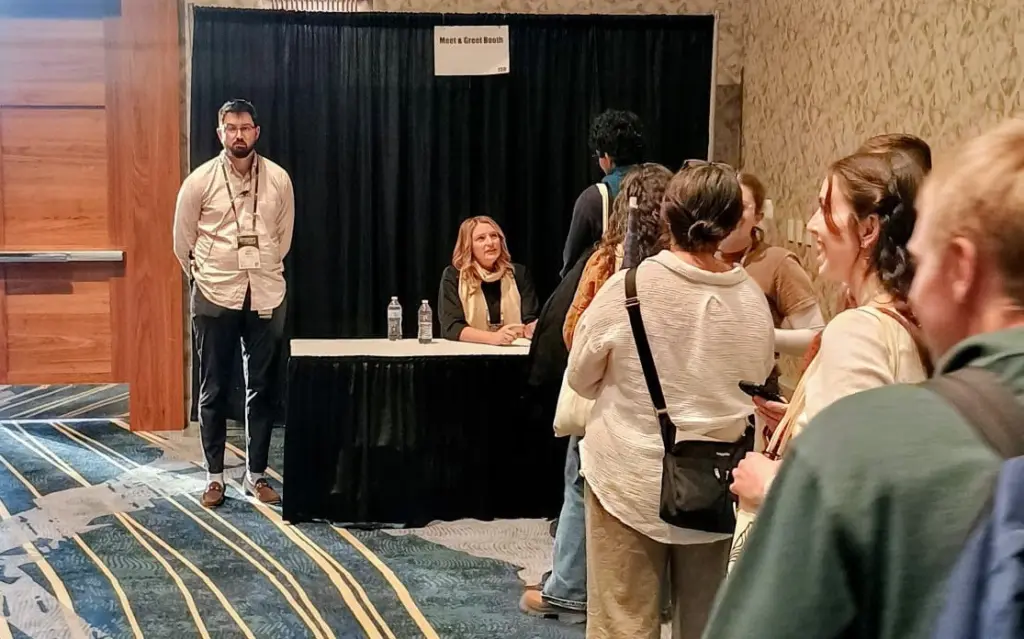
Many students lined up to engage with Reinhardt that the formal Q&A had to be relocated to a separate greeting room, where conversations continued for more than an hour. Students pressed her on navigating campus hostility, engaging friends without fear, and balancing charity with clarity in political conversations.
As the afternoon finally wrapped up, Reinhardt reflected on the sustained enthusiasm.
“This generation of young Catholics really wants to find their voice in the public square, regardless of how messy politics can be,” she said. “They have the energy and the conviction. We need to keep encouraging them and providing them with the tools to do it.”

The post At SEEK Conference, Kelsey Reinhardt explains how ‘Charlie Kirk Effect’ makes case for public faith appeared first on CatholicVote org.