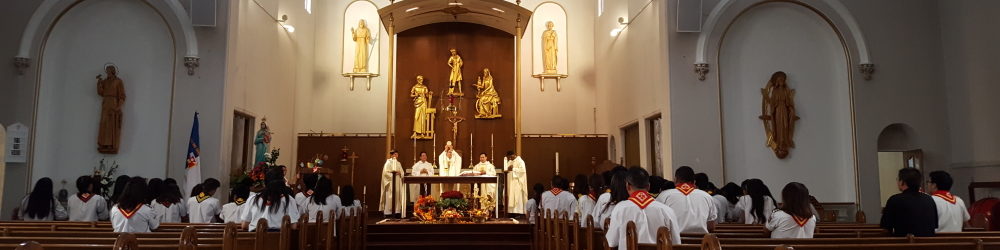

As Easter approaches, a remarkably large group at Kansas State University is preparing to enter full communion with the Catholic Church: At least 110 people, mostly students, along with faculty and staff, are completing the campus ministry parish’s Order of Christian Initiation of Adults (OCIA).
The figure is nearly triple the parish’s usual number, making Kansas State’s Catholic Center, St. Isidore’s, a striking example of a wider surge in young adult conversions being reported across the country.
By mid-summer of 2025, months before the start of fall classes, St. Isidore’s had already surpassed the previous year’s total number of participants. As signups continued to climb, staff adjusted nearly every aspect of the program, adding an additional weekly class time and expanding one-on-one instruction for those joining later in the year.
“It’s felt a little like trying to control the floodgates,” Ridge Pinkston, the director of OCIA at the Kansas State Catholic Student Center, said. “Right when we think we’ve caught up, another ten people sign up.”
Pinkston explained that the parish has always had a strong OCIA program, “but there’s never been anything like this.”
Candidates searching for deeper understanding
Those preparing to enter the Church at Kansas State come from a wide range of starting points. Some were baptized Catholic as children but never completed confirmation, often after their families drifted away from regular practice. Many others come from Protestant communities, while still others arrive without any baptism at all, such as students from nonreligious backgrounds and other faith traditions, including Islam.
Pinkston said that the candidates are “here because they desire a change in their life.”
That desire often shows up in the OCIA classroom, where participants press beyond the introductory explanations in search of deeper understanding.
“They’re asking the questions that help them get to the bottom of something,” he said. “If they don’t understand and they have a question — even if it’s difficult — they’re going to get to the bottom of it.”
Sometimes, he said, that means diving deeper into theology; other times, it takes the form of broader historical questions about how the Church arrived where it is, or what has happened to tradition over time.
“Which is cool, because it’s a sign of intimacy, and a desire for intimacy with the Church on their part” Pinkston said. “They don’t want to just be told what to do. They want to actually understand it.”
A return to what endures
Pinkston, a convert and a member of Generation Z, sees the moment less as a sudden revival than as a long-developing correction. Many of the students entering OCIA, he said, are arriving at the same realization: The frameworks they inherited for making sense of their lives — about identity, fulfillment, and meaning — have not delivered what they promised.
“As we’re coming into our own,” Pinkston said, “we’re realizing that a lot of the things we were given as kids didn’t work, and weren’t fulfilling.”
What follows, in his telling, is not a reactionary turn but a reorientation: a search for what feels durable rather than novel. He described it as “a return to stability,” “a return to consistency,” and, most of all, “a return to personal relationship,” something he believes was missing from the culture more broadly for Gen-Z growing up.
That same search for fulfillment has also shaped how the candidates encounter worship. According to Pinkston, many are drawn, almost instinctively, toward more traditional expressions of the faith, “liturgically and devotionally.”
Pinkston was careful to emphasize that the attraction does not begin with a prior knowledge of Catholic liturgical history or devotion to a particular rite. Most students, he said, encounter these forms of worship before they have the language — or the background — to situate them within the Church’s internal debates.
“I don’t want to put anything in a box, or anyone in a box,” Pinkston added.
However, when given a choice, Pinkston said, students consistently gravitate toward liturgies marked by reverence and beauty.
“They see a Mass that has incense and beautiful vestments versus not,” he said, “and they’re always going to pick that more traditional expression of the liturgy,” even when they cannot articulate what draws them to it.
Pinkston described an intuitive pull toward what feels set apart: an encounter with something that does not mirror the rest of their lives.
“They’re drawn to beauty,” Pinkston said. “To things that feel ancient — different from the rest of their lives.”
Beyond the campus
What makes the Kansas State numbers especially striking is that they are not an isolated phenomenon. According to Pinkston, nearly every parish in the Diocese of Salina is reporting a record year for OCIA participation, including small rural communities in Kansas that have rarely seen more than one or two candidates at a time.
“In a town of 500 people, having five people enter the Church is enormous,” he said. “This is not just the big student centers,” Pinkston said. “It’s happening in little ways in little parishes as well.”
According to Pinkston, the student center itself did nothing different to prompt the growth. Outreach methods remained largely unchanged. “We didn’t change anything,” he said. “So something else changed outside from us. I don’t know what. Obviously, I think that’s the Holy Spirit and something large happening.”
When asked what contributed to the growth, Father Gale Hammerschmidt, the pastor of St. Isidore’s, the Kansas State Catholic Student Center, said, “Obviously this is the work of the Holy Spirit. I also would say the invitation and the joy of those who already called St. Isidore’s their home has also played a role.”
Preparing for an extra large Easter Vigil
The size of the OCIA group has also introduced practical challenges as Easter approaches.
“Having more than 100 participants in our OCIA does indeed create some new concerns in regards to our Easter celebration,” Fr. Hammerschmidt said. “Three years ago, we built and dedicated our new church…that is twice the size of the previous church (350 seats to 700 seats) and still, we are worried about having enough space for our Easter Vigil Mass.”
“This is a wonderful problem,” he added.
As latecomers continue to join the process through January and are supported with additional instruction, the final number may grow even larger, Pinkston noted.
A moment of hope
Asked what guidance he would offer other campus ministries, Pinkston avoided prescribing a formula. He spoke instead about remaining open to whoever arrives and to the many reasons students come through the door.
“Cast the net wide,” he said.
Still, Pinkston was reluctant to claim credit for the growth and continued to point to the Holy Spirit. “I honestly think a lot of this is outside of our control,” he added.
For Fr. Hammerschmidt, the significance of this moment extends beyond the Easter Vigil itself.
“We are filled with gratitude,” he said. “It gives all of us a tremendous amount of hope. Even though it may seem that many have turned away and given up on God, we recognize He has not given up on us.”
“He is continually drawing all of us to Himself,” the pastor added, “and this is the greatest news of all time.”

The post More than 110 people at Kansas State prepare to enter the Church this Easter appeared first on CatholicVote org.