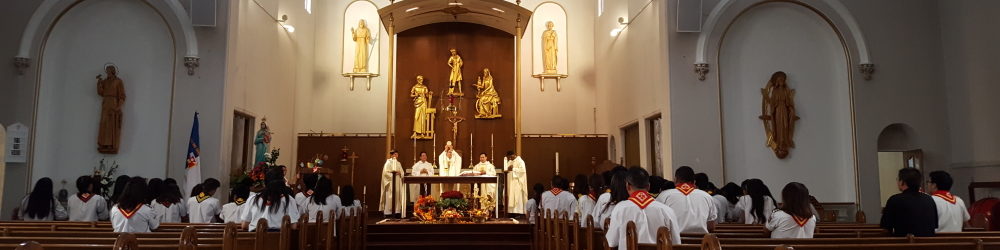
Speaking at the opening Mass of the National Prayer Vigil for Life, Bishop James Conley of Lincoln, Nebraska, reflected on his own conversion, the Church’s understanding of abortion as a foundational moral issue, and expressed hope that a new generation will soon make abortion a thing of the past.
Bishop Conley served as celebrant and homilist for the Jan. 22 vigil Mass at the Basilica of the National Shrine of the Immaculate Conception, at the request of Bishop Daniel Thomas, chair of the United States Conference of Catholic Bishops’ pro-life committee. The liturgy marked the beginning of the Church’s annual prayer observance ahead of the March for Life.
Bishop Conley opened his homily with a story.
“I have not always been pro-life,” he told the congregation. “Unlike many of you, I didn’t have the privilege of a Catholic education.”
Recalling his teenage years in the aftermath of the Supreme Court’s legalization of abortion in 1973, he said the issue simply felt distant and abstract.
“We were taught that the fetus was just a blob of tissue, a mass of cells,” he said. “The science wasn’t very well developed back then, so abortion didn’t really seem like a big deal to me.”
His abstract view of the issue was disrupted, he said, by an experience that left a lasting impression: a high school party where a friend announced his girlfriend’s pregnancy and asked others to help pay for an abortion.
“I remember feeling deep down inside of me that there was something wrong with all of this,” Bishop Conley said. “I didn’t know what, and I didn’t know why. I knew his girlfriend well. We were in middle school together, and I remember feeling very sad for her and for him.”
It would take years for the unease he remembered feeling about abortion to make sense. After a winding path of studying literature, philosophy, art, and music, he immersed himself in the Catholic intellectual tradition and converted to Catholicism while in college. He eventually encountered Humanae Vitae, Pope Paul VI’s encyclical on human life.
“The scales fell from my eyes,” Bishop Conley said. “Now I knew why I felt so uneasy and sad back in high school: For the first time, I saw that human life was a mysterious gift from God, and how each one of us is made in His own image and likeness.”
Referencing the Mass’s first reading, he spoke about how in the “sanctuary of our mother’s womb the Lord has formed us and made us His servants.”
“God had a plan for me, and God has a plan for each one of us,” Bishop Conley said.
He went on to describe how his conversion reframed his understanding of the world.
“I saw how everything was beautifully connected and integrated,” he said, “and how everything had meaning and purpose.”
Quoting St. Teresa of Calcutta, Bishop Conley called abortion “the greatest destroyer of peace.”
He reminded those gathered that the U.S. bishops have long described abortion as the preeminent issue of this age because it entails the direct and intentional destruction of human life at its most vulnerable stage, undermining the right on which all other human rights depend.
The number of lives lost each year, Bishop Conley said, is staggering, and the victims — children in the womb — are uniquely defenseless.
“Our brothers and sisters in the womb are the most vulnerable and most voiceless of victims,” he said, noting that “in most all other cases of injustice, those who are threatened can speak out for themselves and have at least some powers to defend themselves, some form of advocacy.”
Abortion, he said, is also “an attack on the family itself, which is meant to be a sanctuary of life.”
He also pointed to recent remarks by Pope Leo XIV, who reaffirmed the Church’s insistence that the right to life is the foundation of every other human right and criticized the allocation of public resources to facilitate abortion rather than support mothers and families. In that address, the Pope emphasized that the vocation to love and to life — expressed most fully in the committed union of woman and man — carries a fundamental responsibility for the faithful to welcome and care for unborn life, particularly in societies facing steep declines in birth rates.
While welcoming legal developments that have allowed states greater authority to regulate abortion, Bishop Conley emphasized that legislation alone cannot heal the deeper cultural wound that abortion has inflicted.
He highlighted Church initiatives such as parish-based accompaniment for pregnant women and post-abortion healing ministries, including Project Rachel, as essential expressions of the Church’s pro-life witness.
“Our task is not only to change laws,” Bishop Conley said. “It is to build a culture of life and a civilization of love.”
Addressing young people gathered for the vigil, he expressed particular hope for them and their futures.
“My dear young people, you are the pro-life generation,” he told them. “I believe the day will come when your grandchildren will ask whether it is really true that children were once put to death in the womb.”
“Our goal,” he concluded, “is not simply to make abortion illegal. Our goal is to make abortion unthinkable.”
The post Bishop Conley on abortion, conversion, and the pro-life generation at National Prayer Vigil for Life appeared first on CatholicVote org.