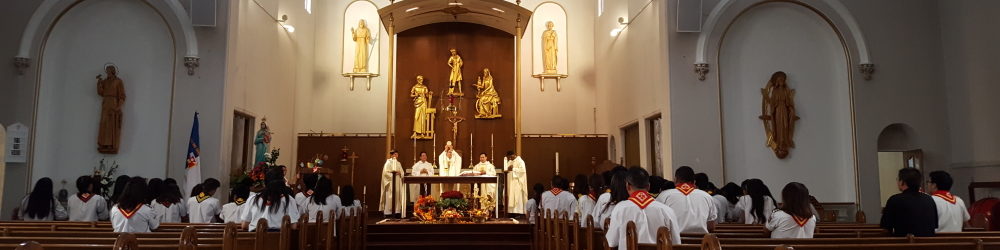
With Pope Leo XIV wrapping up his visit to Lebanon — the heartland of the Maronite Church — the journey highlighted the presence of Eastern Catholic communities within the global Church.
In a Dec. 1 Catholic World Report article, Bishop Gregory John Mansour, who leads the eparchy of Saint Maron of Brooklyn, invited people to learn more. “Come visit our parishes, pray with us, and come to know our communities,” the bishop said.
Bishop Mansour’s eparchy, which has 41 parishes, is one of two in the U.S. The other is the Eparchy of Our Lady of Lebanon of Los Angeles, which has 36 parishes. Together, the eparchies include more than 78,000 Maronite Catholics, who make up 14% of all Eastern Catholics in the nation.
The Maronite Church is one of 23 Eastern Catholic Churches in full communion with the Holy See. The Eparchy of Saint Maron of Brooklyn explains that a church is different from a rite; a church “is a universal community of faith having a distinct tradition founded by an apostle or successor and guided by an autonomous hierarchy by which various nations and peoples have been converted to and nurtured by the teachings of Jesus Christ.”
Each church has its own liturgy, law, theological study of the relationship between God and humans, and spirituality, the eparchy notes. An Eastern tradition means the church originated in the “ancient sees of Antioch, Alexandria and Constantinople,” the eparchy explains. A Western tradition is one that originated in the ancient see of Rome.
“As Jesus commissioned the apostles to go into the world and make disciples of all nations, the early church grew and spread out from Jerusalem,” the eparchy adds. “It experienced other traditions, cultures, customs, languages, art forms, architecture and music. Eastern and Western Christians expressed the same basic truths of their Catholic faith in unique ways and worshiped differently.”
The Maronite Church uses English and Syriac, a dialect of Aramaic, which Jesus spoke, as her liturgical language, and her name has roots in Saint Maron, a hermit and priest who died in 410 AD, according to the Archdiocese of Miami. At a Maronite Mass, there is no kneeling, only sitting and standing throughout, according to the archdiocese. Incense is also used throughout the liturgy.
According to the Order of St. Sharbel, after St. Maron’s death, more than 800 monks based in Syria took on the saint’s monastic way of life and became known as the Maronites.
“The Muslim invasions and conflicts from within the Byzantine Empire caused the Maronites to flee the plains of Syria to the natural protection of the mountains of Lebanon,” the order explains. “By 687, the Maronites elected a patriarch of the vacant See of Antioch and developed as a distinct church within the Catholic Church.”
According to Catholic World Report, in the Eparchy of Saint Maron, there is one wedding per every 250 Catholics and one seminarian for every 8,988 Catholics. Reflecting on what may have a role in the proportionally high number of vocations, Bishop Mansour told the outlet that the eparchy’s parishes are smaller so the priest is close to the faithful.
The outlet asked Bishop Mansour whether Pope Francis’ change in 2014 allowing married men in Eastern Catholic eparchies in the U.S. to enter the priesthood has impacted priestly vocations.
“We take time to promote and carefully discern vocations,” the bishop responded. He described Pope Francis’ change as “a big help for us,” noting that in the eparchy there are 50 celibate priests and 8 married priests.
He also explained that the eparchy requires any married man seeking the priesthood to have been married more than 20 years and have already served as a subdeacon in his home parish and then as a deacon. Any children he has must be older than 18.
“In this way we safeguard the generous-hearted men who will embrace celibacy as well as encourage married men to put his wife and children first, solidify these good relationships, serve his home parish and then be ready to serve like all other celibate priests (be transferred when needed, live on a priest salary and live in a rectory),” Bishop Mansour said.
On Dec. 1, Pope Leo visited the tomb of Saint Charbel Maklūf, a 19th-century Maronite monk and priest whose intercession has been credited with tens of thousands of reported miracles.
Tracy Saba, the media director of St. Sharbel Maronite Catholic Church in Clinton Township, Michigan, told Detroit Catholic that local Lebanese-Americans — many of whom are Maronite — were excited for the Pope’s visit to Lebanon. According to Saba, southeast Michigan is home to one of the largest populations of Lebanese-Americans.
Saba told Detroit Catholic that at the parish named after the beloved saint, parishioners would be praying from Nov. 30 to Dec. 2 for the Pontiff’s trip to be fruitful.
“In Lebanon, our patriarch has asked all parishes to offer special intentions for the pope’s visit,” Saba said. “At St. Sharbel, we are joining in with daily intentions for his safety and a blessed trip, along with adoration and confessions.”
Saba told Detroit Catholic that her parish’s pastor, Chorbishop Alfred Badawi, felt that the Pope’s visit to the saint’s tomb gave a profound message.
“He says that St. Sharbel, who once lived in silence on the mountains, has become a beacon for the whole world,” Saba said. “For him, the pope’s stop at the saint’s tomb shows the Church’s continued love for the East and invites all of us to return to a deeper spirituality of humility and trust in God.”
The post Bishop offers insights on Maronite Catholic Church as Pope Leo concludes historic visit to Lebanon appeared first on CatholicVote org.